Lyme disease is the most commonly reported vector-borne disease in the United States, with the majority of cases occurring in the Northeast. It has been three decades since the agent of the disease, the spirochete Borrelia burgdorferi, and the ticks that vector it were identified. However, the number of Lyme disease cases have steadily increased.
In a new article appearing in the forthcoming issuue of the Journal of Medical Entomology called "What Do We Need to Know About Disease Ecology to Prevent Lyme Disease in the Northeastern United States?" authors from Colorado State University and the Centers for Disease Control assess the potential reasons for the continued lack of success in prevention and control of Lyme disease in the northeastern United States, and they identify conceptual areas where additional knowledge could be used to improve Lyme disease prevention and control strategies.
Some of these areas include: 1) identifying critical host infestation rates required to maintain enzootic transmission of B. burgdorferi, 2) understanding how habitat diversity and forest fragmentation impacts acarological risk of exposure to B. burgdorferi and the ability of interventions to reduce risk, 3) quantifying the epidemiological outcomes of interventions focusing on ticks or vertebrate reservoirs, and 4) refining knowledge of how human behavior influences Lyme disease risk and identifying barriers to the adoption of personal protective measures and environmental tick management.
The article briefly summarizes existing prevention and control strategies and tools aimed at reducing human exposure to vector ticks and B. burgdorferi, and highlights conceptual areas where additional studies on the enzootic transmission cycle or the human-tick interface are needed to fill in the knowledge gaps preventing the development of novel, more effective Lyme disease prevention strategies and tools or the implementation of existing ones.
Because the likelihood of human exposure to the tick and the pathogen both can be influenced by human behavior, the authors focus not only on the density of infected ticks, which represents the fundamental (or acarological) risk of human exposure to B. burgdorferi, but they also provide an overview of studies that identify behavioral risk factors and explore areas where additional information in this field are needed.
The full article is available at http://www.entsoc.org/PDF/2012/EC-11-138.pdf.
The Journal of Medical Entomology is a bimonthly peer-reviewed journal that publishes reports on all phases of medical entomology and medical acarology, including the systematics and biology of insects, acarines, and other arthropods of public health and veterinary significance. It is published by the Entomological Society of America, the largest organization in the world serving the professional and scientific needs of entomologists and people in related disciplines.
###
Monday, January 9, 2012
How can Lyme Disease be Prevented and Controlled?

Saturday, January 7, 2012
Wissenschaftler weisen Behauptungen von Greenpeace bezüglich Gentech-Mais zurück
Lanham, MD; 6. Januar 2012 – Eine Publikation ist im Druck im neuesten Journal of Integrated Pest Management (JIPM) weist die Behauptungen von Greenpeace Deutschlad zurück,dass der Western Bean Cutworm (WBC), zu deutsch etwa 'Westlicher Bohnenschneider', Striacosta albicosta (Smith) als eine neue Schädlingswelle verursacht ist durch Gentech-Mais. Der deutsche Greenpeace-Report, verfasst duch Christoph Then von Testbiotech enthält nach den JIPM-Autoren überraschend simple Schlussfolgerungen bezüglich der Ausbreitung des WBC über das letzte Jahrzehnt.
In "Genetically Engineered Bt Corn and Range Expansion of the Western Bean Cutworm (Lepidoptera: Noctuidae) in the United States: A Response to Greenpeace Germany," (korrespondierender Autor William Hutchinson, Professor und Direktor des Entomologie-Departments an der Minnesota University) und seine Ko-Autoren halten fest, dass der Greenpeace Bericht zusätzliche Faktoren in breiterer ökologischer und agronomischer Sicht vermissen lässt, die die Ausbreitung des Cutworms erklären. Dieses zusätzlichen Faktoren umfassen auch die Biologie des Schädlings, die Synchronisierung von Schädlings- und Mais-Entwicklung, reduzierten Inektizid-Verbrauch, Reduktion des Pflügens, Bodentypen, Einsatz herbizid-toleranter Sorten, Insektengenetik, Insekten-Pathogene, voraus existierende Insekten-Populationsdichte und Klimawandel.
Die JIPM-Autoren beleuchten mehrere faktische Widersprüche und Falschinterpretationen im Dokument von Greenpeace, die schon bei der Titelwahl beginnen: „Gentechnisch veränderter Mais fördert Ausbreitung von Schädlingen.“
Entgegen den Behauptungen von Greenpeace ist der Western Bean Cutworm (WBC) weder „neu im Gebiet“, noch hat er neulich „massive Schäden“ verursacht. Der WBC wurde erstmals in Arizona um 1880 gefunden und als ernstzunehmender Schädling bereits 1915 erkannt. Über die letzten drei Jahrzehnte hat sich sein Vorkommen erweitert, aber der ökonomisch dokumentierte Infektions-Schaden hielt sich verhältnismässig in Grenzen. Die Bahauptung von Greenpeace, dass der WBC früher auf kleine Gebiete begrenzt war und keine grösseren Probleme in Maiskulturen verursachte, ist auch nicht wahr nach den Autoren. Bauern in Nebraska berichteten von grossen Problemen bereits ab 1962 und anstelle der „auf kleine Gebiete limitierten“ Vorkommen war der WBC durch die ganzen Western Great Plains von Mexico bis nach Alberte verbreitet, wo es bereits mitte der 50er Jahre gefunden wurde, trotz der Greenpeace – Behauptung, dass der WBC in Kanada erst kürzlich erstmals um 2009 festgestellt wurde.
Merkwürdig ist nach den Autoren, wie Then im ganzen Greenpeace Bericht 2010 andere Einflussfaktoren der Ausbreitung des WBC einfach weglässt, inklusive mehrerer ökologischer und agronomischer Faktoren. So zum Beispiel hat der steigende Einsatz von Conservation Tilling seit Mitte der Neunziger Jahre die winterliche Boden-Überlebensrate des WBC begünstigt wegen dem weniger tiefgehenden Pflügen. Andere Ursachen der Ausbreitung liegen in der Reduktion oder sogar Elimination von Insektizid-Anwendungen im letzten Jahrzehnt, resultierend in höheren Überlebensraten. Auch andere Ausbreitungs-Ursachen wie Klimawandel wurden im Greenpeace – Testbiotech - Bericht ignoriert.
Um zu vermeiden, dass “potentielle Fehlinterpretationen durch selektive Zitate” aus dem Greenpeace – Bericht zu Verwirrung under zukünftigen Regulierungsexperten in ihren Entscheidungen führen könnten, geben die Autoren spezifische Antworten auf andere Behauptungen im Greenpeace – Bericht.
Diese Antworten, und die vollständige IIPM-Publikation können heruntergeladen werden: http://www.entsoc.org/PDF/2012/JIPM-Greenpeace.pdf.
Das Journal of Integrated Pest Management ist ein elektronisch offen zugängliches Journal mit externer Peer review, das das ganze Gebiet des Integralen Pest-Management abdeckt. Es ist das Organ der Entomological Society of America, der grössen solchen Organisation, die sich um die professionellen und wissenschatlichen Bedürfnisse der Entomologen und Vertreter ähnlicher Gebiete kümmert.
Presse-Anfragen sollten gerichtet werden an:
Dr. William D. Hutchison, PhD
University of Minnesota
(612) 624-1299; hutch002@umn.edu
Dr. Thomas E. Hunt
University of Nebraska
(402) 584-3863; thunt2@unl.edu
Dr. Gary L. Hein
University of Nebraska-Lincoln
(402) 472-3345; ghein1@unl.edu
(Translation: Klaus Ammann)
Friday, January 6, 2012
Scientists Refute Greenpeace Claims About GM Corn
Lanham, MD; January 6, 2012 -- An article in the forthcoming issue of the Journal of Integrated Pest Management (JIPM) refutes claims by Greenpeace Germany that the western bean cutworm (WBC), Striacosta albicosta (Smith), is "a new plant pest" that was "caused by genetically engineered corn." The Greenpeace Germany report, which was written by author Richard Then of Testbiotech, offers a "surprisingly simplistic conclusion" regarding the spread of western bean cutworm over the last decade, according to the JIPM authors.
In "Genetically Engineered Bt Corn and Range Expansion of the Western Bean Cutworm (Lepidoptera: Noctuidae) in the United States: A Response to Greenpeace Germany," corresponding author William Hutchison, professor and chair of the University of Minnesota Department of Entomology, and his co-authors maintain that the Greenpeace report fails to consider broader ecological and agronomic factors which explain why the WBC's range has expanded. These additional factors include insect biology, synchrony of insect and corn phenology, reduced insecticide use, increases in conservation tillage, soil type, glyphosate-resistant crops, insect genetics, insect pathogens, pre-existing insect population densities, and climate change.
The JIPM authors focus on several discrepancies of fact and interpretation in the Greenpeace document, beginning with its title, “Agro-biotechnology: New plant pest caused by genetically engineered corn. The spread of the western bean cutworm causes massive damage in the U.S.”
Despite the Greenpeace claim, the WBC is neither "new" nor has it caused "massive damage" recently. The WBC was originally collected in Arizona in the 1880s and was considered an economic pest of beans and corn as early as 1915. Over the last decade its range has expanded, but documentation of economically damaging infestations has been relatively limited.
The Greenpeace claim that the WBC has historically "been confined to very limited regions and did not cause any major problems in maize crops" is also untrue, according to the authors. Farmers in Nebraska reported major problems as early as 1962, and instead of being "confined to very limited regions," the WBC was documented throughout the western Great Plains from Mexico to Alberta, where it was found in the mid 1950s, despite the Greenpeace claim that it was found in Canada for the first time as recently as 2009.
According to the authors, "a curious theme throughout the Greenpeace Germany report, is that Then (2010) ignored the possibility of other influences on western bean cutworm range expansion, including several ecological and agronomic factors." For example, the increasing use of conservation tillage since the mid-1990s favors the survival rate of WBC larvae because less deep plowing minimizes mortality to insect pests that overwinter in the soil. Another possible reason is the reduction or elimination of insecticide applications, which has occurred with increased use of Bt corn over the past decade, likely resulting in increased survival of the WBC. Other possibilities for the WBC range expansion, such as climate change, were also ignored by Greenpeace and Testbiotech.
Out of concern that "potential misinterpretation of selected quotes" in the Greenpeace report may lead to confusion among future regulatory decision makers, the authors go on to give specific responses to other claims in the report.
These responses, and the full JIPM article, can be downloaded at http://www.entsoc.org/PDF/2012/JIPM-Greenpeace.pdf.
The Journal of Integrated Pest Management is a peer-reviewed, open-access, extension journal covering the field of integrated pest management. It is published by the Entomological Society of America, the largest organization in the world serving the professional and scientific needs of entomologists and people in related disciplines.
Media Inquiries should be directed to:
Dr. William D. Hutchison, PhD
University of Minnesota
(612) 624-1299; hutch002@umn.edu
Dr. Thomas E. Hunt
University of Nebraska
(402) 584-3863; thunt2@unl.edu
Dr. Gary L. Hein
University of Nebraska-Lincoln
(402) 472-3345; ghein1@unl.edu
###
Thursday, December 1, 2011
Using Radiation to Sterilize Light Brown Apple Moth
Using Radiation to Sterilize Light Brown Apple Moth
Lanham, MD; November 30, 2011 -- A new study published in the Journal of Economic Entomology shows that radiation can be used to effectively sterilize the light brown apple moth (LBAM), an insect pest found in Australia, New Zealand, California, Hawaii, Sweden, and the British Isles. The light brown apple moth, Epiphyas postvittana (Walker), feeds on apples, pears, stonefruits, citrus, grapes, berries and many other plants. A native of Australia, it has been found in California since 2007. The California Department of Food and Agriculture has spent more than $70 million in CDFA and USDA funds to eradicate the LBAM, and estimates that failure to eradicate it could cost California growers over $133 million per year.
The article, "Radiation Biology and Inherited Sterility of Light Brown Apple Moth (Lepidoptera: Tortricidae): Developing a Sterile Insect Release Program" is available now in PDF format at http://bit.ly/vuH0sT.
Using similar methodologies in two different laboratories, the authors coordinated radiation biology studies between two geographically isolated LBAM populations from Australia and New Zealand. The results showed that for both populations, an irradiation dose of 250 Gy administered to LBMA pupae induced >95% sterility in females and >90% sterility in males. These results can be used to initiate a suppression program against the LBMA where sterile males are released, mate with wild females, and no offspring are produced. If successful, this technique can largely eliminate the need for pesticides.
"These results suggest that a sterile insect technique (SIT) or F1 sterility program can be applied to control an infestation of Epiphyas postvittana, but these would still be reliant on complementary information such as physical fitness and modeling of overflooding ratios." according to the authors. "The challenge now is to identify the dose of radiation that would provide a balance between insect sterility and field competitiveness."
The Journal of Economic Entomology is published by the Entomological Society of America (http://www.entsoc.org), the largest organization in the world serving the professional and scientific needs of entomologists and people in related disciplines.
###
Friday, October 28, 2011
Press Registration for Entomology 2011
Lanham, MD: October 28, 2011 -- Entomology 2011 (http://entsoc.org/entomology2011), the 59th Annual Meeting of the Entomological Society of America (ESA), is the world's most important annual conference on insect science anywhere. For four days, ESA’s Annual Meeting will bring together thousands of the scientific leaders of entomology –- scientists, researchers, educators, students, and others from around the globe -- who will participate in 86 symposia.
Topics will include honey bees, Colony Collapse Disorder (CCD), Bed bugs, stink bugs, biodiversity, biofuels, pest management, arthropod disease vectors, the 5,000 Insect Genome Project, invasive species, climate change, social insects, the state of entomology in Japan after the earthquake and tsunami, and many others. In addition, the meeting will feature the Linnaean Games, an Insect Photo Salon, the Cockroach Monologues, Buzzwords, awards ceremonies, and numerous social events. The full program is available at http://entsoc.org/entomology2011.
Members of the media who would like to attend can contact the ESA (sro@entsoc.org; 301-731-4535, ext. 3009) for a press pass. Proper media credentials must be presented upon arrival during registration for the meeting, and the credentials must show a direct affiliation with an accredited news organization (print, TV or radio). Public Information Officers from universities may also receive press passes with proper credentials and ID.
Freelance journalists who do not have media credentials and a professional affiliation will not receive press passes. However, exceptions will be considered by the Executive Director of the ESA if freelancers belong to the National Association of Science Writers or a similar organization.
Companies or organizations producing publications, videos, and/or other electronic media intended for marketing, advertising, financial analysis, or public relations purposes may not register as members of the media.
For more information, contact Richard Levine at rlevine@entsoc.org.
The Entomological Society of America (ESA) is the largest organization in the world serving the professional and scientific needs of entomologists and people in related disciplines. Founded in 1889, ESA today has more than 6,000 members affiliated with educational institutions, health agencies, private industry, and government. Members are students, researchers, teachers, extension service personnel, administrators, marketing representatives, research technicians, consultants, and hobbyists. For more information, please visit http://www.entsoc.org.
###
Monday, October 24, 2011
Ento2011 Mobile App

ESA has gone mobile! You can now access the latest ESA Annual Meeting program information, schedules, news, and announcements, and you can create a personal schedule, link to exhibitors, and connect with other attendees―all from your smart phone.
The app is available via the Android Market and the iPhone App Store, and it's also available as a mobile web app and as a web-based application for desktops and laptops.
The app is fully integrated with the Confex abstract management system so you have the latest information at your fingertips! The app for Android is available now and for two weeks after the meeting. The iPhone app will be available later this week.
Download the Ento2011 mobile app now!
For iPhone (coming later this week)
For the 2012 Annual Meeting, a sponsorship opportunity is available for the mobile app. If your company is interested, contact Scot Oser, ESA's advertising sales manager, at soser@entsoc.org
Thanks to Alex Wild Photography for the photo of Temnothorax rugatulus. Ants in this laboratory nest are individually marked with dabs of paint to help researchers at the University of Arizona track their activities.
Friday, October 14, 2011
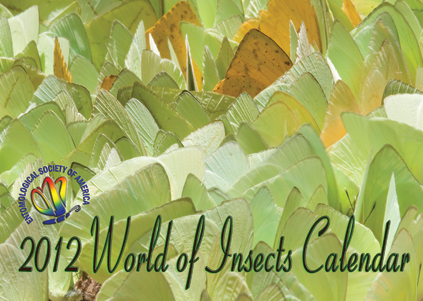
2012 World of Insects Wall Calendar
http://entsoc.org/Pubs/Calendar
The ESA 2012 World of Insects wall calendar is available on a first-come, first-served basis.
All registrants at the 2011 ESA Annual Meeting are entitled to one free copy with their registration.
Additional copies are available by using the order form. There are no returns permitted for the ESA calendar and all sales are final.
Click here for pricing information and an order form.


 Posts
Posts

